ChatGPT Prompts for Literature Review – Summarize and Compare Papers
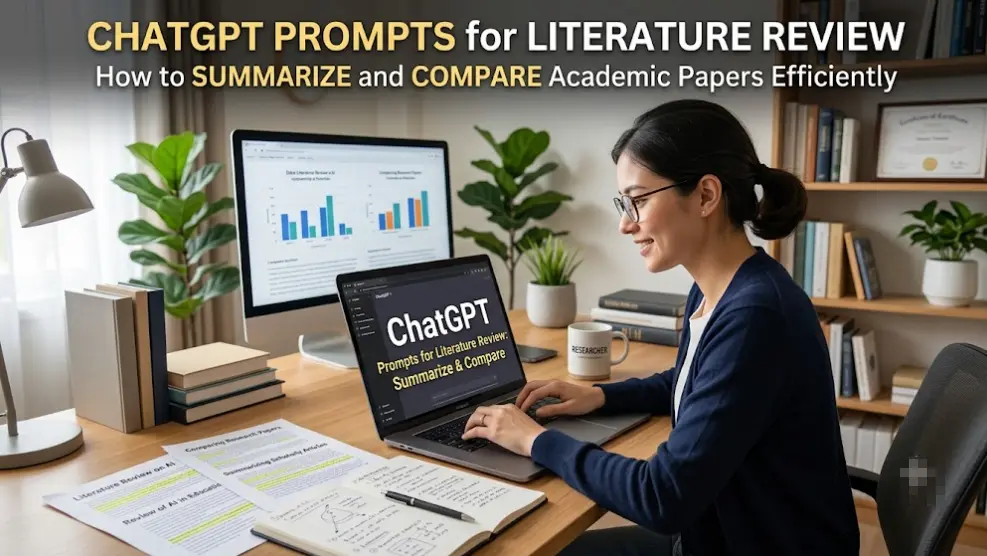
ChatGPT prompts for literature review work best when you provide the actual paper instead of asking the model to summarize it from a title alone. Without the original text, it may get details wrong, including author names, sample sizes, or citations that don’t exist. The four prompts below are designed to work with a paper you’ve pasted or uploaded, so you can check the results against the original source.
They cover four common tasks: summarizing a paper, comparing studies, identifying research gaps, and evaluating methodology. I’ve also included a simple workflow and a few things to keep in mind when using AI for academic research.

Before You Paste a Paper
- Provide the actual text. Upload the PDF or paste the relevant sections. Don’t rely on the model’s memory for details about a specific study.
- Allow it to say “Not reported.” If the paper doesn’t provide a particular detail, the model should say so rather than guess.
- Ask for quotes or page numbers. A short quote alongside each extracted fact makes it easier to find and verify the information in the original paper.
Four ChatGPT Prompts for Literature Review
Prompt 1: Summarize a Research Paper
Use this prompt to extract the same information from each paper you read. Keeping the format consistent makes it easier to organize your notes later.
Copy and paste this prompt:
Role: Academic research assistant

Context: I am writing a literature review on [YOUR RESEARCH TOPIC].

Task: Read the attached paper and extract the following:
1. Research question or main hypothesis
2. Methodology and data, including sample size, variables, and models where applicable
3. Key findings, including numerical results when reported
4. Limitations explicitly acknowledged by the authors
5. Relevance to [YOUR RESEARCH TOPIC]

Constraints:
- Use only the text I provided.
- If an item isn't stated, write "Not reported."
- Include a short supporting quote or page number for each item.
- Do not invent details or references.
Prompt 2: Compare Multiple Papers in a Table
After summarizing a few papers, use this prompt to compare them side by side. The table can help you spot differences in research design, findings, and the questions each study leaves open.
Copy and paste this prompt:
Task: Build a Markdown table comparing the [NUMBER] papers provided below.

Columns:
- Author(s) and year
- Main objective
- Methodology and data source
- Key findings
- Limitations or research gaps mentioned by the authors

Instructions:
- Keep each cell concise.
- Base every entry only on the provided papers or summaries.
- If information is missing, write "Not reported."
- Do not invent author details, findings, or citations.
Prompt 3: Identify Patterns, Conflicting Findings, and Research Gaps
Once you’ve collected several paper summaries, this prompt can help you see how the studies relate to one another. Use the results as a starting point for organizing your literature review, not as a substitute for reading the papers.
Copy and paste this prompt:
Task: Analyze the paper summaries below and identify:

1. Findings or conclusions the studies agree on
2. Conflicting findings, methods, or theoretical explanations
3. Research questions that remain unanswered across these studies
4. Possible directions for future research supported by the provided material

Instructions:
- Use only the information in the summaries.
- Name the relevant paper or authors for each claim.
- Distinguish between gaps explicitly mentioned by the authors and gaps you infer from the studies.
- If the available information isn't enough to support a conclusion, say so.

Format: Use clear headings and bullet points.
Prompt 4: Evaluate a Study’s Methodology
Use this prompt when a paper plays an important role in your review. It can help you identify weaknesses worth examining, but you’ll still need to judge whether those concerns actually affect the study’s conclusions.
Copy and paste this prompt:
Task: Evaluate the research design and methodology of the attached paper.

Consider:
- Internal and external validity, where applicable
- Potential sources of bias, including selection bias and reporting bias
- Whether the sample size and sampling method are appropriate for the research question
- Whether the conclusions are supported by the data and analyses presented
- Any methodological limitations acknowledged by the authors

Instructions:
- Base each comment on the provided paper.
- Quote the relevant passage or provide a page number for each point.
- Distinguish between confirmed limitations and potential concerns.
- Do not assume a study is flawed simply because it has limitations.
- If the paper doesn't provide enough information to assess an issue, say so.

Tone: Academic and neutral.
👉 ChatGPT: smart and simple AI – ChatGPT: AI made simple
A Simple Literature Review Workflow
You don’t need to use all four prompts on every paper. A straightforward approach is to summarize each study first, compare the results, and then look for patterns across the research.
| Step | Tool or prompt | Purpose |
|---|---|---|
| 1. Find papers | Consensus, Elicit, SciSpace | Find potentially relevant research papers and check their sources. |
| 2. Extract information | ChatGPT or Claude, Prompts 1 and 2 | Summarize individual papers and compare their methods and findings. |
| 3. Analyze the research | ChatGPT or Claude, Prompts 3 and 4 | Look for patterns, disagreements, research gaps, and methodological concerns. |
| 4. Verify everything | Original papers | Check extracted facts, quotations, page numbers, and references against the original sources. |
Check Citations and AI Disclosure Rules
Never assume a citation generated by AI is accurate. Before including a reference in your literature review, check the original paper or its DOI record to confirm the authors, title, publication details, and other relevant information. The prompts can help organize your reading, but the interpretation of the research and the argument you make in your review still need your own judgment.
Check your university’s or target journal’s policy on AI use before submitting your work. Some institutions and journals have specific disclosure requirements, and the rules can differ depending on how AI was used.
If you’re new to using ChatGPT for academic research, start with Prompt 1 and a paper you’ve already read. You’ll be in a better position to spot missing details or a summary that doesn’t quite match the original text.
Articles you might find helpful:
👉 AI Prompts for Legal Document Summarization and Contract Review
👉 ChatGPT Prompts for Accountants – Excel Formulas & Summaries