
AI Prompts for Real Estate Listings – 3 Templates to Copy
AI prompts for real estate listings work better when you give the AI the same details you’d mention to a buyer at an open house: the layout, what was updated, and what the street is like. A prompt that only says “write a listing for a 3-bedroom house” usually gets you the same “stunning” and “nestled in the heart of” copy you’ve already read a hundred times.
Below are the parts I’d include in a prompt, followed by three templates for an MLS description, an Instagram caption, and a luxury listing. Fill in the brackets and paste them into ChatGPT, Claude, or whichever assistant you use.
What to Put in a Real Estate Listing Prompt
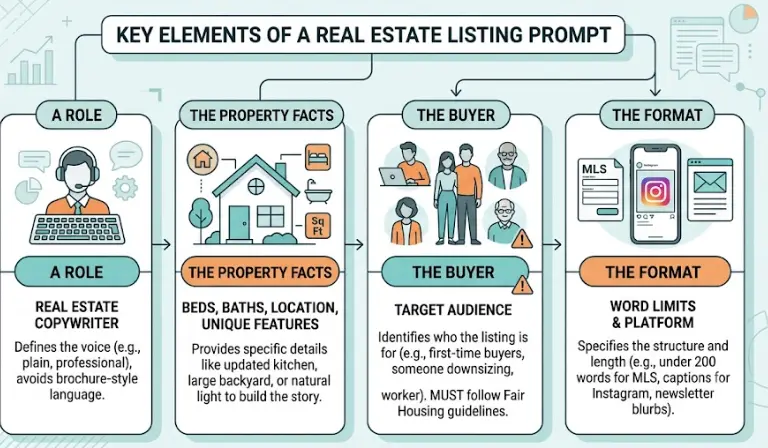
Four things make the biggest difference.
A role. Something like “you’re a real estate copywriter” gives the AI some direction on the voice. Without it, the output can easily sound like a brochure.
The property facts. Bedrooms, bathrooms, square footage, location, and one or two features that set the home apart. An updated kitchen or a south-facing backyard gives the AI more to work with than “great home.”
The buyer. Say who the listing is written for, such as first-time buyers, someone downsizing, or an investor. Keep in mind the Fair Housing notes further down, because this is also where prompts can go wrong.
The format. MLS fields have word limits, Instagram captions don’t, and a newsletter blurb sits somewhere in between. Tell the AI which one you need.
Three Prompts You Can Copy
MLS Listing Description
This one keeps to a word limit and focuses on how the home might be used day to day, rather than just listing the specs.
You are a real estate copywriter. Write an MLS listing description under 200 words for this property:

Property type: [e.g., 3-bed, 2-bath single-family home]
Location: [e.g., Austin, TX]
Key features: [e.g., updated kitchen with quartz countertops, large backyard, lots of natural light]
Likely buyer: [e.g., someone working from home who needs a spare room]

Describe how the space is used (morning light in the kitchen, room to work from home) instead of only listing specs. Skip words like "stunning," "breathtaking," and "must-see." Keep the tone plain and professional, and follow Fair Housing Act guidelines.
Instagram or Facebook Caption
You are a social media manager for a real estate agency. Write an Instagram caption for a new listing:

Neighborhood: [e.g., Capitol Hill, Seattle]
Three highlights: [e.g., rooftop deck, floor-to-ceiling windows, pet-friendly building]
Price and status: [e.g., just listed at $650,000]

Open with a line that makes someone stop scrolling. Use a few emojis, end with a call to action (for example, "DM us to book a showing"), and add 5 to 8 hashtags related to the neighborhood and the property type.
Luxury Listing
Higher-end listings often rely more on materials, privacy, and setting, so this prompt focuses on those details.
You are a real estate marketer who writes for high-end residential listings. Write a narrative description of about 250 words for this property:

Architectural style: [e.g., modern craftsman]
Premium features: [e.g., heated pool, chef's kitchen with Sub-Zero appliances, mountain views]
Likely buyer: [e.g., someone looking for privacy and room to entertain]

Focus on the craftsmanship, the privacy, and what daily life in the house would feel like. Keep the language polished but not stiff, and avoid generic luxury phrases.
Fair Housing – Check Before You Publish
Whatever the AI writes, you’re the one who publishes it, so read every listing before it goes live. Fair Housing rules cover race, religion, sex, disability, and familial status, among others. A phrase like “perfect for young families” or “quiet Christian neighborhood” can be a problem even if the AI wrote it. Describing the home itself is the safer route: “open layout, two blocks from the park.”
AI models can also get details wrong. Square footage, school district names, and HOA rules are worth checking against your own records. And if a prompt would include a seller’s financial details or private client notes, leave those out. If you’re unsure about a particular phrase, your broker or compliance contact is the right person to ask.
A prompt template can save some time on the first draft, but the version that ends up on the listing usually has a few of your own edits in it. That’s probably the part no template can cover.
Check out these related posts:
👉 ChatGPT for HR – Writing Job Descriptions and Interview Questions