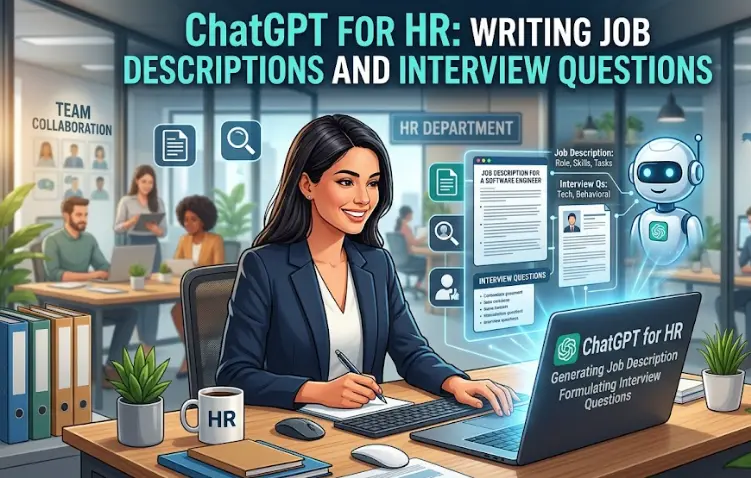
ChatGPT for HR – Writing Job Descriptions and Interview Questions
ChatGPT for HR work is most useful at the first-draft stage: a job description for a role that doesn’t exist yet, or a set of interview questions you need before tomorrow’s panel. The model knows nothing about your company until you tell it, so a recruiter still has to edit what comes back. The blank page is the part it takes off your hands.

What to Put in an HR Prompt
Typing “Write a PM job description” gets you a page that could belong to any company. Compare that with a prompt that says the role is a mid-level product manager for a B2B SaaS tool, at a 50-person e-commerce company, hybrid, working in two-week sprints. The second version gives the model enough context to work with.
A few details make a noticeable difference:
- The role itself: title, seniority, industry, and what the person is hired to accomplish.
- The company: size, team culture, and whether the work is remote, hybrid, or in the office.
- The format you want back: bullet points, named sections, or a table.

Prompt for a New Job Description
This one works for a role you’re writing from scratch. Replace the bracketed parts with your own details.
Act as a senior HR director. Write a job description draft for a [mid-level B2B SaaS product manager] in the [e-commerce] industry. Use these sections: Role Summary, Key Responsibilities (5 bullet points), Required Qualifications (4 items), and Preferred Qualifications (3 items).
If you already have a draft and it reads stiffly, paste it in with a rewrite request instead:
Rewrite the job description below so it is clear, professional, and engaging for applicants. Keep the requirements as they are.
[paste your draft here]
Adding “keep the requirements as they are” is worth the extra few words. Without it, the model can sometimes reword a requirement into something slightly different.
Interview Questions Based on the JD
With the job description finished, the same conversation can produce the interview set. Because the model can see the responsibilities you just approved, the questions tend to follow them fairly closely.
Based on the Key Responsibilities in the job description above, write 5 interview questions that test the candidate’s core skills. Phrase each one so it asks for a real past example, following the STAR method (Situation, Task, Action, Result).
The questions are only part of an interview guide. Interviewers also need some idea of what a strong answer looks like, so you can ask for that next:
Make a Markdown table for the 5 questions above. For each question, add one column describing a good answer and one column describing a weak answer or red flag.
This won’t replace an interviewer’s judgment, but it can give everyone on the panel the same reference point when evaluating answers.
Where ChatGPT Gets HR Work Wrong
Invented requirements. The model can list tools, certifications, or skill combinations that don’t match how the role works at your company. Have the hiring manager read the technical requirements before anything is posted.
Confidential information. Unannounced product names, internal financials, and candidate personal details don’t belong in a public AI tool. Replace them with placeholders before pasting anything in.
Generic tone. The default voice is standard corporate language. A job description that sounds like every other posting gives candidates little sense of what working with your team is like, so add a few lines in your own voice after the draft is done.
Check out these related posts:
👉 AI Prompts for Real Estate Listings – 3 Templates to Copy
A Last Note
Try one of these prompts on a role you’re hiring for this month and see which sections come back too general. Those are usually the areas where the prompt needs more detail.